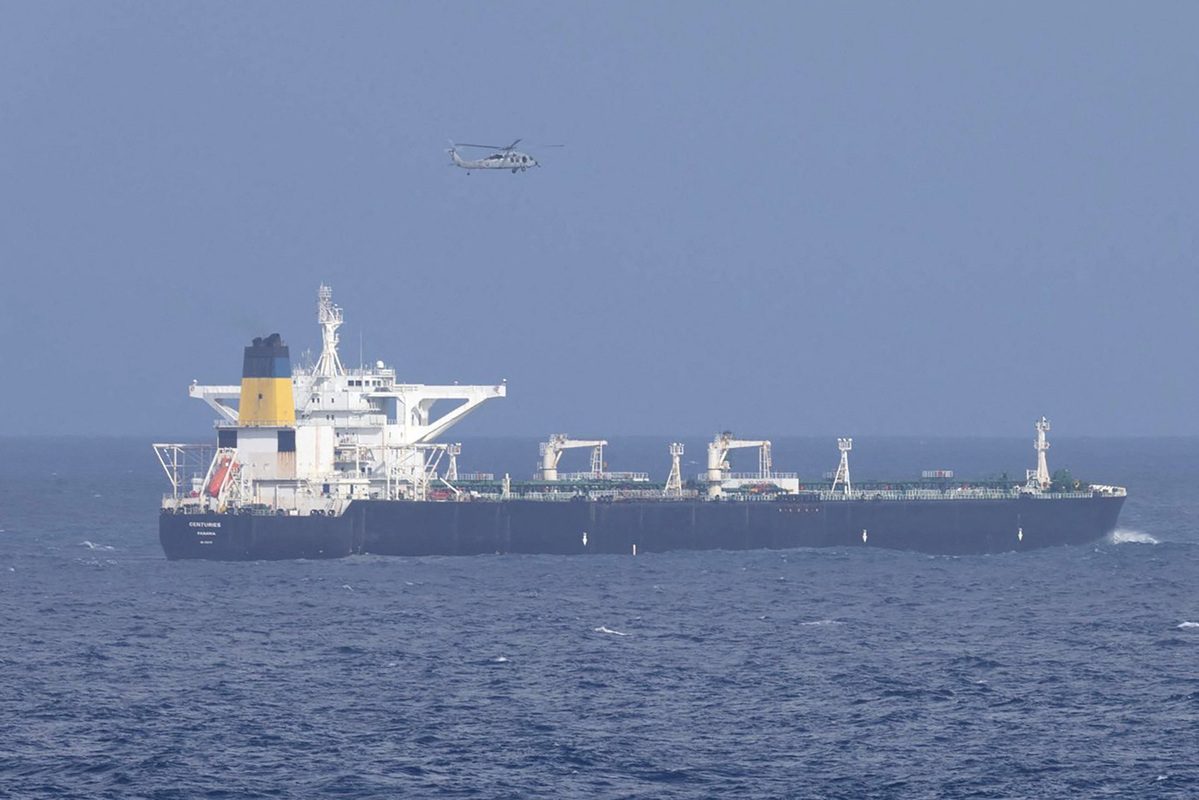
A US military helicopter flies over the Panama-flagged Centuries, which was intercepted by the US Coast Guard, days after US President Donald Trump announced a "blockade" of all sanctioned oil tankers entering and leaving Venezuela, east of Barbados in the Caribbean Sea, Dec 20, 2025. [Photo/Agencies]
Editor's note: US strikes on Venezuela and the capture of President Nicolas Maduro has been condemned globally as a serious violation of international law and national sovereignty. Two Chinese experts share their views with China Daily's Wang Qingyun and Li Huixian. Excerpts follow:
US strikes blatant hegemonic invasion
After a swift military strike against Venezuela on Saturday, the US administration announced that Venezuelan President Nicolas Maduro and his wife were "captured and flown out of the country". Subsequently, the US administration said it would "run" Venezuela "until such time as we can do a safe, proper and judicious transition". The lightning speed at which it all happened sent shock waves across the globe.
The official explanation the US has offered for its military action was "combating drug trafficking" and "protecting regional security". However, clearly there are far-reaching intentions behind the operation.
In the United States' recently issued National Security Strategy, the US administration focused on putting the Western Hemisphere first, and proposed the so-called "Trump Corollary to the Monroe Doctrine". It declared that the US would restore "American preeminence" in the Western Hemisphere to prevent "foreign hostile forces" from gaining a foothold in key regional assets and influence. The strategy includes a stronger military presence, stricter border and drug controls, more active political influence mechanisms and the use of force when necessary.
The US military strike on Venezuela is a concentrated embodiment of the "corollary-style Monroe Doctrine" in practice. First, through military intervention, the US administration is moving away from a pattern which involved only imposing economic sanctions and diplomatic isolation. Saturday's strike is a case of direct military intervention, demonstrating US military presence in the Western Hemisphere at the strategic level.
Second, the strike was undoubtedly aimed at reshaping the regional power structure and balance of influence. Even in the National Security Strategy, the US clearly prioritizes curbing the influence by "competitors" as a key focus of its Western Hemisphere policy.
In this context, Venezuela carries symbolic significance, being an important partner of China in energy and infrastructure cooperation and a crucial node for Chinese investment and the Belt and Road Initiative's extension into Latin America. The US, through military intervention, disrupted the political stability of this key node.
The core logic is to strengthen the US' discourse power as the dominant force in the Western Hemisphere through violent deterrence and political intervention.
Of course, this strategy will come with significant backlash. Latin American countries have long sought strategic autonomy and diverse cooperation options. The US' excessive militarized intervention could prompt these countries to reassess their foreign strategies, even to deepen their resistance to external intervention, thereby fostering closer South-South cooperation. Thus, the use of hard power does not necessarily lead to the expected strategic compliance but may instead exacerbate tensions and security predicament in the region.
In summary, this event is both a strong signal of the US' strategic intentions and a high-risk gamble in the US' adjustment of its global strategy. It represents a clear and thorough rejection of international cooperation and multilateral rules, and declares the US' determination to impose its "hard power" on the international order, use military force to redefine its geopolitical influence boundaries and return to "backyard hegemony".
Zhao Pu is an assistant researcher at the Institute of American Studies of the Chinese Academy of Social Sciences.
US 'neocolonialism' cannot conquer justice
US troops invaded Venezuela on Jan 3, illegally capturing President Nicolas Maduro and his wife and taking them out of the country. The US claimed it would prosecute them on US soil for facilitating drug trafficking, an act that not only severely undermines international law and tramples on international norms but also has profound implications for regional stability. At its core, the US aims to plunder Venezuela's abundant oil and gas reserves and reassert comprehensive control over the Western Hemisphere, essentially reenacting "neocolonialism" in the Americas.
Following the commencement of Trump's second term, the United States has significantly intensified its intervention and assertion of interests in the Western Hemisphere, introducing the "Trump Corollary to the Monroe Doctrine", which vividly showcases the essence of hegemonism. The current Venezuelan government is seen as a cornerstone of the anti-American bloc, and for over two decades, the US has unsuccessfully attempted to achieve regime change in the country through various means.
During Trump's first term, the US supported opposition leader Juan Guaidó against the Maduro government, but the efforts failed. On resuming the presidency, Trump, confronted with global turmoil, urgently needs to establish US authority, gain tangible benefits and political capital, and fulfill the "America First" campaign promise, with Latin America being the easiest target for such endeavors.
By acting against Venezuela the US achieves a "triple win". First, Venezuela has abundant oil and gas reserves, from which the US can seize a large amount to gain substantial profits.
Second, overthrowing President Maduro serves as a deterrent to other Latin American countries that are not aligned with the US, warning them against opposing the US. Especially as an increasing number of Latin American countries attempt to pursue independent paths and explore mutually beneficial cooperation with major countries outside the region, the US aims to force Latin American countries to choose sides.
Third, it influences the regional political landscape by building a pro-American bloc. Latin American countries have entered a new era, with right-wing presidential candidates winning elections in Ecuador, Bolivia, Chile, and Honduras in 2025; these newly elected leaders generally express a desire to strengthen cooperation with the US. As Brazil, Colombia, Peru and Costa Rica are set to hold elections in 2026, it is no surprise that the US seeks to expand its influence in the region to secure greater benefits.
However, such calculated maneuvers may backfire. Chilean President Gabriel Boric has condemned the US military operation in Venezuela and warned that "tomorrow it could be any other country".
More Latin American people are opposing the resurgence of the "Monroe Doctrine" and striving for an independent path. While might may overthrow a regime, it can never conquer the pursuit of justice.
中新经纬2月18日电(李晓萱)打扰一下,龙年开工第一天,你领到老板发的红包了吗? 微信推出面对面红包 据微信官方18日消息称,微信推出了“面对面红包”。具体内容如下: 新年开工,一声:“老板,新年好!”道出了多少期 龙年春节档的卖相与怪相 龙年春节档迎来尾声。回望春节前夕,无超级大片,多数影片都是熟面孔且不举行首映,观众进影院如开盲盒。以“贾玲减重100斤”为首的各种营销策略铺天盖地袭来,一度让部分观众产生逆反心理,对 多地景区人气旺 世界同享中国年 龙年旅游消费迎来火爆开局 本报记者 潘福达 多家景区门票售罄约满、多地酒店“一房难求”、出入境旅游均增长明显……春节假期旅游消费火爆,成为拉动居民消费的主力军。根 八部影片半数撤档 春节档为何出现罕见“撤档潮” 据猫眼专业版数据,截至昨日17时,2024春节档总票房破80亿,总人次1.62亿,总场次383.6万,全面刷新中国影史春节档纪录。然而,几家欢乐几家愁,今年春节档冷热不均,出现了罕 作者:陈灿平(天津市人民检察院副检察长)厦门是习近平生态文明思想的重要孕育地和先行实践地,筼筜湖综合治理是习近平生态文明思想的重要发端。1988年,习近平同志在厦门工作期间主持启动“综合治理 “新年刚过,我已经买好了十一旅游的机票” 中新网北京2月23日电(张钰惠)在年初就买好全年的旅行机票,是一种怎样的体验?近日,三亚、哈尔滨等网红城市的天价返程机票引发关注。为了最大程度上避开高价机票,压缩旅 。本文链接:US actions signal a return to imperialism, colonialismhttp://www.sushuapos.com/show-5-84987-0.html
声明:本网站为非营利性网站,本网页内容由互联网博主自发贡献,不代表本站观点,本站不承担任何法律责任。天上不会到馅饼,请大家谨防诈骗!若有侵权等问题请及时与本网联系,我们将在第一时间删除处理。
上一篇: US attack on Venezuela is warfare dressed as lawfare
下一篇: Economic Watch: Easier entry, simplified tax refunds draw foreign tourists to shop in China